29-07-2026
A common error is committed by most people at home. They opt for an inverter that is larger than the battery. There are high hopes of having longer backup time. Then comes the first prolonged power outage. The system does not deliver as anticipated.
There is continuous beeping from the inverter. The battery runs out sooner than usual. It takes too much time to recharge. In some cases, the fault lies with the inverter. In others, it lies with the battery. In most cases, however, the trouble lies in their combination. Inverters and batteries are meant to function as one unit. They cannot be bought separately.
One System, Two Different Jobs
The inverter and the battery play different roles. The inverter controls the load. It converts battery energy to usable energy. The inverter also recharges the battery once power supply is restored from the mains.
The battery serves as the source of energy. Thus, using a bigger inverter does not necessarily mean long backup. Likewise, using a bigger battery does not solve problems with inverter sizing based on the load.
Start With The Appliances, Not The Product
Before selecting any inverter to be installed in the house, there must be a need for establishing which appliances should operate during the power failure.
One house could require two fans, three lights, Wi-Fi, and a television, while another could also include a laptop, CCTV, or even a fridge. These are certainly different requirements from one another.
While a store requires lights, billing, cameras, and internet, a house will have no use of anything but the basics. This is why a load calculation of a simple inverter becomes so important. In its absence, people end up buying an inverter just because of the low price or high brand value.
Load And Backup Time Are Not The Same
Here, most consumers become confused. Inverter capacity indicates the load that an inverter can support. Battery capacity, on the other hand, determines how long this load can run.
For instance, two households might have the same inverter. However, the first household has only lights and fans. The other has lights, fans, a TV, router and computer. The latter household will experience reduced battery backup.
Battery capacity is equal. Load is greater. Therefore, when people ask about the best home power backup option, the solution cannot be one particular inverter or battery capacity. It depends on what the customer wants.
Charging Compatibility Is Often Ignored
Battery charging is another important part of the system.
After a power cut, the battery needs enough time to recover. If the inverter charges it too slowly, the battery may still be low when the next outage begins.
On the other hand, the wrong charging setup can also affect battery health. This is why inverter battery compatibility should be checked before purchase.
Buyers should confirm:
- Battery voltage
- Supported battery type
- Battery capacity range
- Charging current
- Expected charging time
- Daily power-cut pattern
These details may look technical, but they decide how well the system works in daily use.
Bigger Numbers Can Create The Wrong Expectation
Larger inverters sound great. But larger capacity only means that it can accommodate larger load. This doesn’t mean that your battery will last longer.
In reality, people tend to connect more appliances after purchasing a larger inverter, thus causing their battery to drain faster. The same situation is true about a large battery. In case your inverter doesn’t recharge it, the whole system may take a long time to restore itself.
Backup comes from good balance. Your inverter should be compatible with your load, your battery with required time, and your charging system with your battery.
A Simple Real-Life Example
Consider a situation where the household requires mainly fans, lights, Wi-Fi, and mobile phones to charge. This household does not require the same configuration as a business which uses a computer, printer, cameras, lights, and billing machine. The requirements of both could include inverters.
However, their load profile would be different. Their backup time would be different. Even their battery charging requirements would be different. That is why Mission does not treat inverter and battery as two separate products. The complete requirement comes first.
Mission’s Step Towards Complete Backup
Mission Batteries has handled batteries for domestic, vehicular, solar energy, and commercial applications. Our new line of inverters is headed to offer us a more comprehensive backup solution. The objective is quite straightforward.
The inverter must complement the battery. The battery must complement the load. The entire system must complement the pattern of actual power cuts that the user experiences. The system that would be required by a customer who experiences short power cuts is different from another one who experiences prolonged power cuts.
A shop needs a different system from what is needed by a home. There is no point in offering a customer a bigger system than what they require. On the other hand, offering them a smaller system will just earn you complaints in the future.
Common Questions Buyers Ask
Does A Bigger Inverter Give More Backup?
No. A bigger inverter can handle more load, but the battery decides the available backup time.
Can I Use Any Battery With Any Inverter?
Not always. Voltage, battery type, capacity, and charging support should match.
How Do I Choose An Inverter For Home?
List the appliances you need during a power cut. Then check the total load, required backup time, and battery charging needs.
Why Does My Battery Take Too Long To Charge?
The battery may be too large for the inverter’s charging capacity. The charger, wiring, battery condition, and power supply can also affect charging time.
Final Thoughts
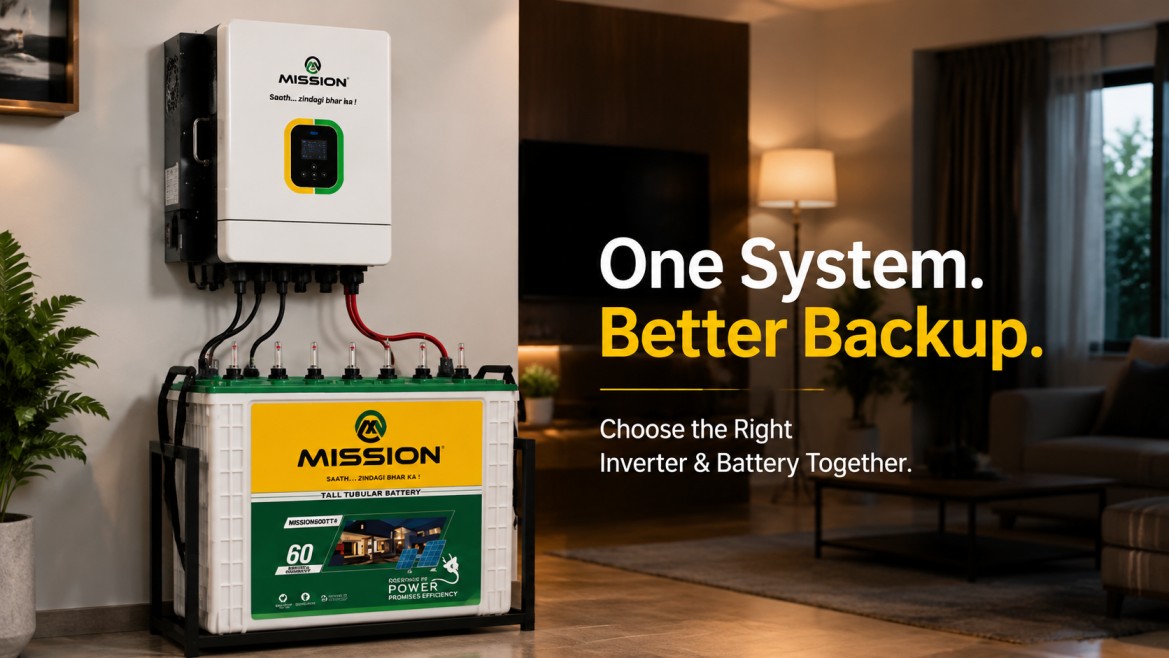
An inverter and battery work best when they are planned together. The inverter manages the load. The battery stores the energy. The charging system connects both. If one part does not match, backup becomes weak or unreliable.
At Mission Batteries, our focus is on helping users build a balanced power backup system. Not a setup that only looks good on paper, but one that works properly during an actual power cut. Because the best backup system is not always the biggest one. It is the one that fits the user’s real need.